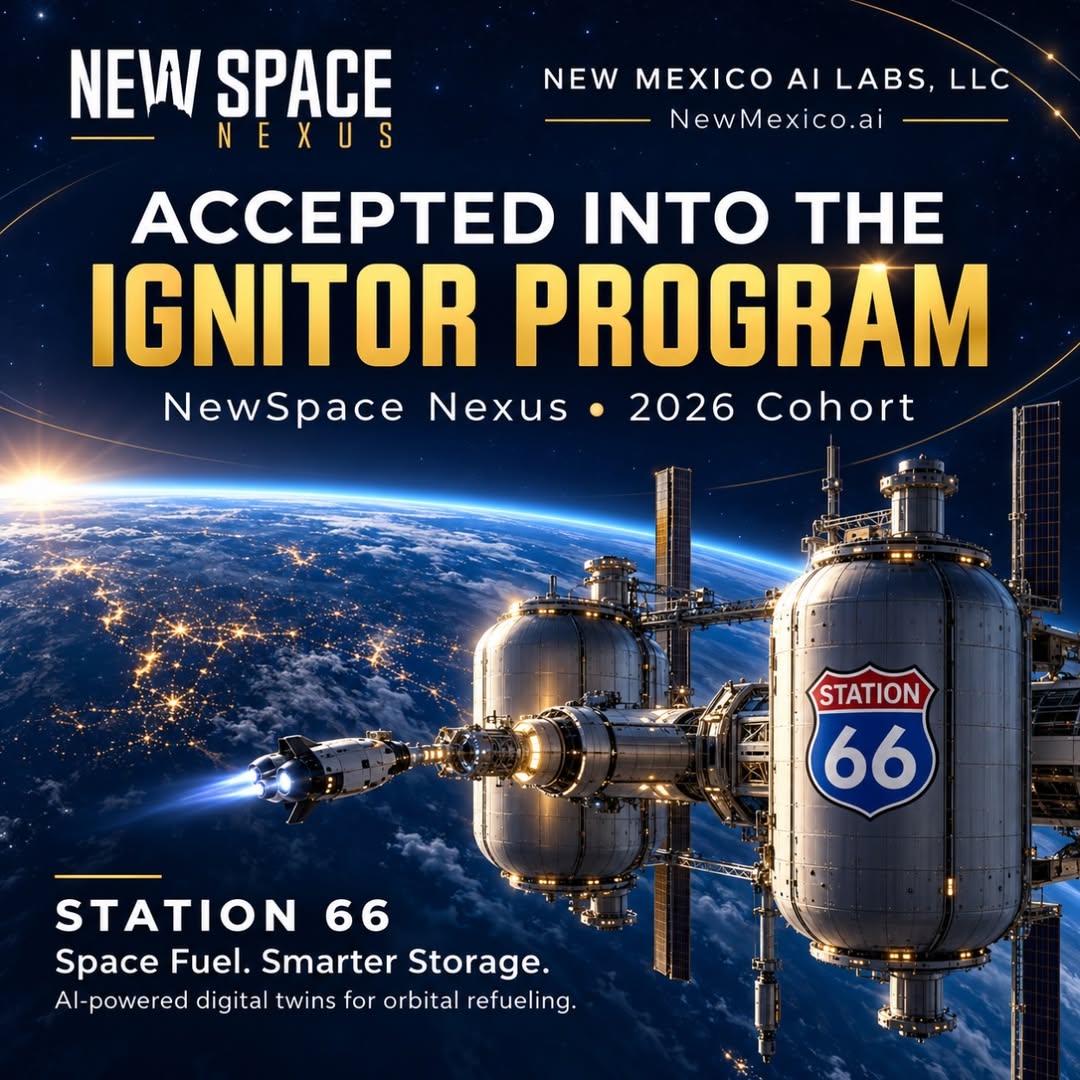
Physics-informed digital twins for orbital refueling depots.
Space needs gas stations—and smarter ways to manage the fuel. Station 66 deploys physics-informed neural networks to monitor, predict, and control how cryogenic propellants behave in microgravity.
Solving thermodynamic boil-off and fluid dynamics in low-gravity environments.
Propellants do not settle predictably in microgravity. Surface tension, residual accelerations, and slosh dynamics complicate mass gauging, phase separation, and fluid transfer.
Extreme solar thermal flux and orbital cycles drive pressure spikes and boil-off venting. Station 66 provides predictive models to minimize thermal losses and maximize tank longevity.
Edge-deployed AI models run real-time state estimations on station avionics—eliminating ground telemetry lag and enabling autonomous cryogenic fluid management.
Standard deep learning treats physical systems as black boxes. Station 66 embeds Navier-Stokes equations, thermodynamic phase-change laws, and orbital heat transfer equations directly into the neural network loss function.
// Loss Function Embedded With Navier-Stokes & Thermal Physics
Loss = MSE_data + λ_pde * (∇ · u) + λ_thermo * (∂T/∂t + u · ∇T - α∇²T)
> Monitoring: LOX / LH2 / LCH4
> Regime: Microgravity (0g / μg)
> Target: Long-Duration Propellant Depots
> Status: Model Training & Validation
Proud to share that New Mexico AI Labs, LLC has been accepted into the NewSpace Nexus Ignitor Program’s 2026 cohort!
Our project, Station 66, is developing physics-informed AI to monitor and predict how cryogenic propellants behave in microgravity—helping future orbital refueling stations manage fuel storage and reduce losses.
Thank you, NewSpace Nexus! We’re excited to get to work alongside this year’s cohort.